
The "Big Light" Rule: Why Closer Is Usually Better
There is a distinct moment in every photographer’s journey when the gear stops being an exciting mystery and starts feeling like a barrier. Usually, this happens the first time you step into a professional studio and see the massive softboxes, the rolling C-stands, and the complex-looking strobe units. It’s easy to feel like you need a degree in physics just to make a portrait look natural.
At Von Creative, we believe that the best work happens when the technical details fade into the background, leaving room for the creative vision to take center stage. One of the most common "technical" hurdles we see photographers struggle with is understanding the relationship between distance and light quality. You might have heard of the Inverse Square Law: a phrase that sounds more like high school calculus than art.
But in the studio, we prefer a much simpler name for it: The "Big Light" Rule.
The "Big Light" Rule is the secret to that soft, ethereal, high-end skin texture you see in editorial spreads. It’s the reason why, counter-intuitively, moving your light closer to your subject often makes it look softer, more flattering, and infinitely more professional.
Why We Get Intimidated by the Math
In the photography world, we love our jargon. We talk about f-stops, shutter speeds, and Kelvin temperatures. But the Inverse Square Law is often the peak of that intimidation. Essentially, it’s a physics formula that explains how light intensity drops off as you move the light source further away.
But here’s the secret: you don’t need the math. You just need to understand the feeling.
When you’re working in our 2,000-square-foot co-working studio, you have the space to move. You have a 22-foot wide cyclorama wall and a 25-foot picture box trim wall that give you the freedom to position your lights anywhere. The temptation is often to pull the lights back to "get them out of the way" or to "light the whole room."
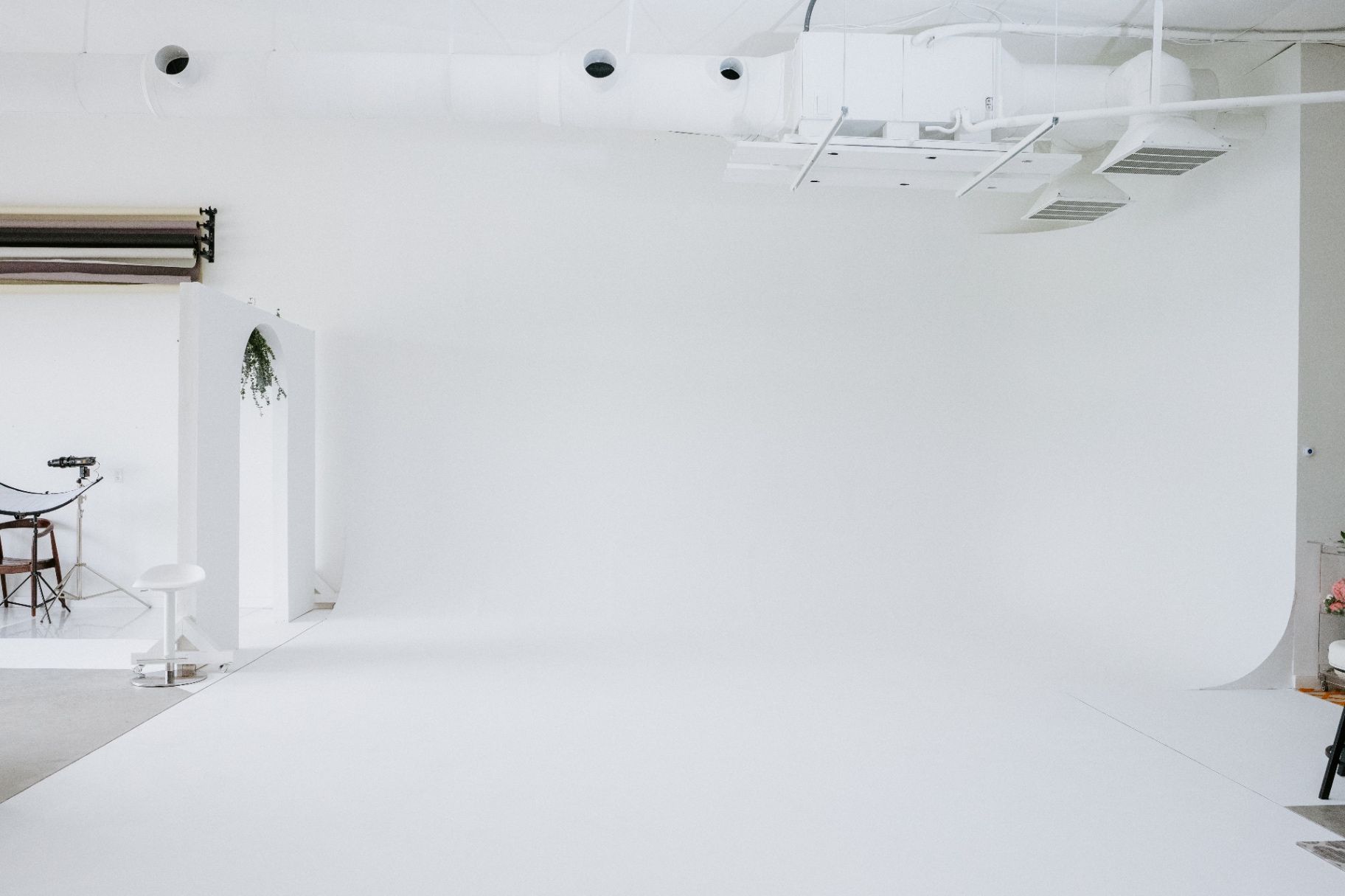
However, pulling the light back is often the fastest way to make your lighting look amateur: hard shadows, flat skin, and zero "mood."
The "Big Light" Rule: The Simplification
If you take nothing else away from this guide, remember this: The bigger the light appears relative to your subject, the softer the shadows will be.
This is why the sun (which is massive but millions of miles away) looks like a tiny, hard point in the sky that creates harsh shadows. And it’s why a medium-sized softbox placed two feet from a model’s face looks like a soft, glowing window.
When we talk about the "Big Light" Rule, we’re talking about Apparent Size.
Close = Big: When you bring a softbox or an umbrella close to your subject, it occupies a large portion of their field of vision. The light "wraps" around their features, filling in the shadows and smoothing out skin texture.
Far = Small: As you move that same light away, it becomes "smaller" in relation to the subject. The light rays become more parallel, the shadows become sharper, and the skin texture becomes more pronounced.
The Magic of the "Wrap"
Why does skin look better with close light? It’s all about the "wrap."
Imagine a model standing on our white cyclorama wall. If you place a large 5-foot octabox just three feet from her, the light doesn't just hit her face from the front; it hits from the sides, the top, and the bottom of that large surface area. This creates a gentle gradient between the highlighted areas of the face and the shadows.
This is the hallmark of professional portraiture. It’s what makes the skin look healthy and luminous. When the light is close, it can literally "reach" around the curve of a cheekbone or the bridge of a nose, softening the transition into shadow.
In our studio, we provide access to over 900 items and professional lighting tools, including various modifiers designed specifically to help you achieve this wrap. Whether you’re using a deep parabolic umbrella or a massive silk scrim, the goal is always the same: make the light feel "big."
The Falloff: Your Secret Weapon for Depth
The second half of the "Big Light" Rule involves something called Falloff. This is the part of the Inverse Square Law that actually works for you, even if you never learn the formula.
When a light is very close to your subject, the intensity of the light drops off very quickly as you move away from the source. This might sound like a bad thing, but for a photographer, it’s a superpower.
Dramatic Separation: If your light is three feet from your subject and the background is ten feet away, the light hitting the background will be significantly dimmer than the light hitting your subject. This creates instant depth and separation, making your subject pop without you having to do anything in Photoshop.
Controlling the Vibe: If you want a moody, dark background while still having beautiful light on your subject’s face, the answer isn't necessarily to buy a black backdrop: it’s to bring your light closer to the subject and move the subject away from the wall.
Conversely, if you are shooting a large group or want the background to be as bright as the subject, you move the light further away. This creates a "slower" falloff, meaning the light level stays more consistent over a longer distance. This is why we designed our shooting space to be 40 feet wide; it allows you the distance needed to minimize lens distortion and achieve that even, consistent light across large scenes when necessary.
Practical Application: A Step-by-Step Guide
The next time you’re in the studio for one of our Studio Discount Days or a private rental, try this simple experiment to see the "Big Light" Rule in action:
Start with a Large Modifier: Grab the largest softbox or umbrella available in our equipment closet.
Position It Close: Place the light so close to your subject that it’s almost in the frame. (A good rule of thumb is about 2–3 feet away).
Adjust Your Power: Because the light is so close, it will be very bright. Turn your strobe power down to its lowest settings.
Observe the Skin: Look at how the light rolls across the subject’s face. Notice the soft edges of the shadows.
Move It Back: Now, move that same light 10 or 15 feet away. Increase your strobe power to maintain the same exposure.
Compare: Notice how the shadows have become harsher, the background has become brighter, and the overall "mood" has flattened out.
The "Big Light" Rule Checklist
When you’re setting up your next shoot at Von Creative, run through this quick checklist to ensure you’re making the most of your light:
Is the light big enough? Use a modifier that is at least as large as the subject's head (for portraits) or torso (for fashion).
Is the light close enough? If you want soft skin and a dark background, bring the light in.
Is there enough distance between the subject and the wall? To take full advantage of light falloff, give your subject some breathing room from the backdrop.
Are the shadows doing what I want? If they are too "crunchy," bring the light closer or use a larger modifier.
Beyond the Physics: A Focus on Hospitality
At Von Creative, we know that technical skills are only one part of the equation. A successful shoot is also about the experience. That’s why our studio is designed with more than just lighting in mind. From our beverage station and baby changing area to our high-speed fiber internet and on-site staff, we strive to provide an elevated experience for you and your clients.
When you aren't worried about whether the light is "right" or if your client is comfortable, you can focus on the connection. The "Big Light" Rule is just one way we help you simplify the process so you can get back to what you love: creating beautiful, meaningful images.
Recap
The Inverse Square Law simplified: The "Big Light" Rule tells us that closer light equals softer shadows and more dramatic falloff.
Apparent Size is key: A light source is only "soft" if it looks large from the subject's perspective.
Control your background: Use close light to create rapid falloff, darkening the background and creating depth.
Use the space: Our 2,000-square-foot studio and 40-foot wide shooting area give you the literal room to experiment with these distances.
Equipment matters: Access to professional modifiers like those in our Studio Journal collection makes achieving high-end lighting effortless.
Experience the "Big Light" for Yourself
Ready to put the "Big Light" Rule into practice? Whether you're a seasoned pro or just starting to experiment with OCF (Off-Camera Flash), Von Creative is the perfect playground for your next project.
Book your studio rental today and discover how easy professional lighting can be when you have the right space and the right rules to follow. Join us for our next networking event to connect with other creatives and see these principles in action. Let's make light work, together.