
Rent First or Open Your Own Studio? The Photographer’s Real-World Cost & Break-Even Guide
A photography studio is not just lights, backdrops, and one suspiciously expensive cute chair.
It is a lease. A build-out. Utilities. Maintenance. Insurance. Cleaning. Client comfort. Inventory. Marketing. Downtime. And enough runway to survive the awkward stretch where the space is ready, the bills are ready, and the bookings are still warming up.
That is where a lot of photographers get blindsided. They budget for the visible gear and forget the invisible business infrastructure. The strobes make the mood board. The HVAC bill does not. The paper backdrop is easy to remember. The deposit, repairs, internet, software, cleaning, liability coverage, and months of overhead are easier to lump into a vague “I’ll figure it out later,” which is, unfortunately, how later gets expensive.
This guide is built around a more useful question than What do I need to start?
When should a photographer rent a studio, and when should they open their own?
Let’s look at start up costs for having your own studio.
Starting with the building blocks, below is an example of things to factor in when calculating your own studio startup costs. Example amounts are provided, but please feel free to fill these in with your own quotes to find a solid starting base.
Bare-minimum startup costs
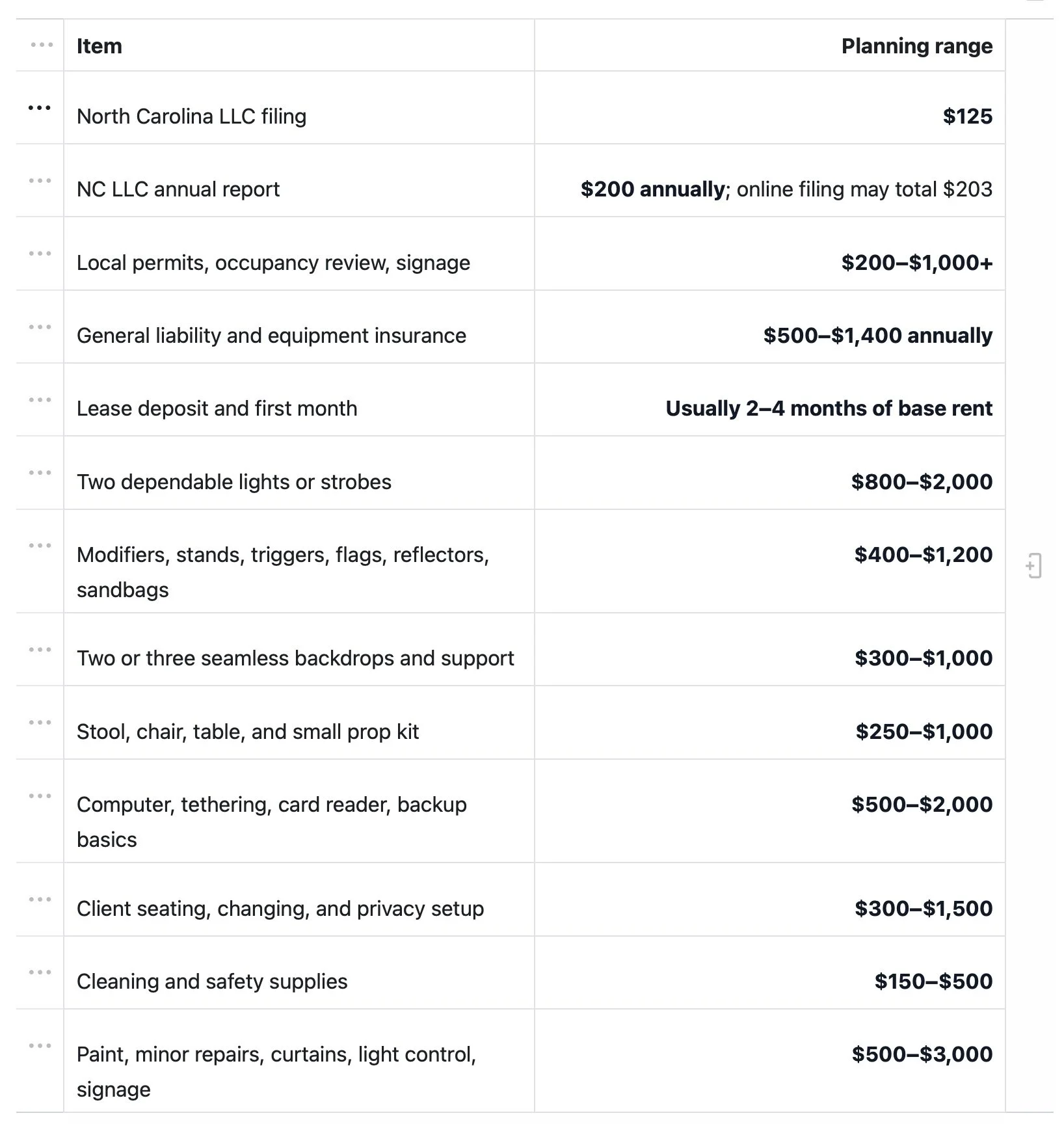
The equipment ranges assume you already own a camera, primary lenses, and editing computer, or that those costs are budgeted separately. Used professional gear can absolutely lower the initial bill, but reliability matters more than having the newest shiny thing.
The lease deposit is often the largest immediate cash requirement. A space advertised at $1,500 per month may require $3,000–$6,000 before you have purchased a single backdrop. Ask whether the lease is gross, modified gross, or NNN. Taxes, insurance, and common-area maintenance can sit on top of the quoted base rent, which is why “the rent seemed fine” is not always the end of the story.
What rent may look like in North Carolina
Current North Carolina listing research shows asking rates around:
Office and retail: approximately $9–$25 per square foot annually
Industrial and warehouse: approximately $6–$18.26 per square foot annually
Some North Carolina retail examples: roughly $1,600–$3,300 per month
These are asking-rate examples, not official market averages or guaranteed lease terms. NNN/CAM charges may be additional.
**What is NNN? Triple Net Lease. In an NNN lease, the tenant typically pays: base rent, property taxes, building insurance, and common-area maintenance (CAM). So the advertised rent may look management, but the actual monthly cost can be higher once those pass-through expenses are added.
Illustrative base-rent math:
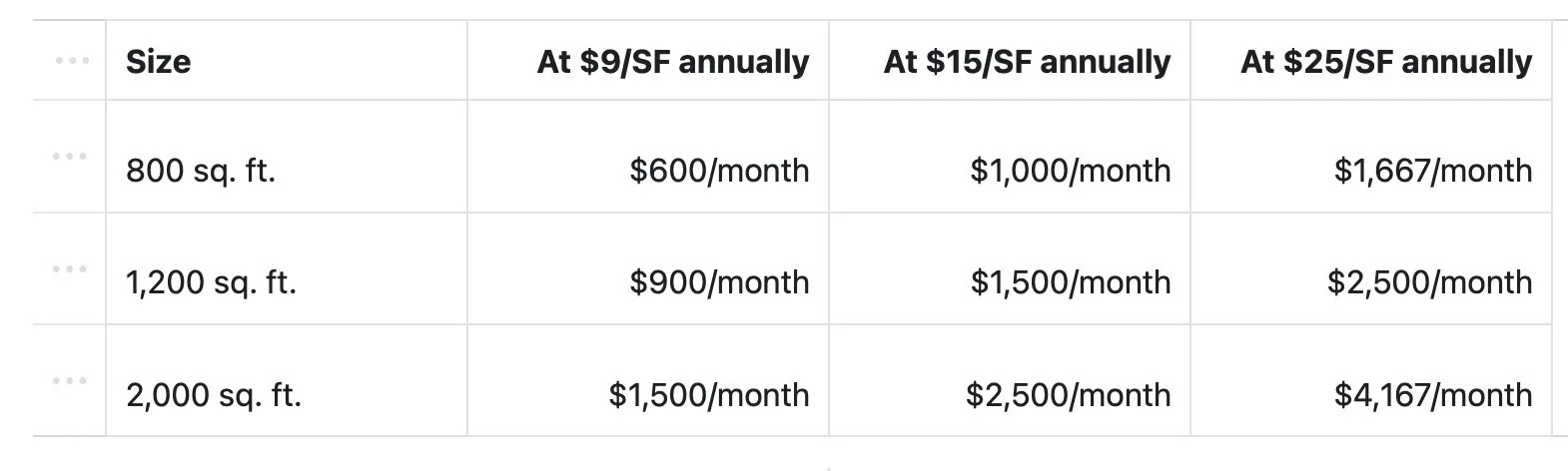
An 800-square-foot studio may be affordable, but it can get tight quickly once you add clients, assistants, lights, changing space, and storage. A larger studio can create better shooting distance and more flexibility, but every extra square foot eventually has to justify itself.
Before signing, confirm:
Permitted use and occupancy classification
Ceiling height, power capacity, HVAC, and restroom access
Parking, accessibility, and load-in
Noise restrictions and sound control
Fire-code requirements
Signage rules
Who pays for improvements, repairs, and restoring the space
How much does it cost to open a studio?
These are broad planning figures, not contractor bids.
Open-the-doors lean studio: $5,000–$12,000
This assumes a mostly ready-to-use space, gear you already own, modest furnishing, and limited improvements. It can be unrealistic if you must finance equipment or pay a large deposit.Small dedicated studio: $15,000–$35,000
This includes deposits, basic improvements, equipment, insurance, launch costs, and a more complete client setup, but not a substantial operating reserve.Polished or build-out-heavy studio: $35,000–$80,000+
This may include a cyclorama, electrical work, flooring, custom sets, sound treatment, professional furnishings, and larger equipment inventory.
A garage or major conversion requires its own estimate:
Basic conversion: $8,000–$15,000
Mid-range conversion: $15,000–$25,000
Professional or full conversion: $30,000–$50,000+
A best-case 800-square-foot studio budget
This is an illustrative example for a small, mostly ready-to-use studio designed to help you better calculate where you might be.
Monthly expense model:
Base rent: $600/month, based on 800 square feet at an illustrative $9/SF annual asking rate
NNN/CAM or property pass-through allowance: $150/month
Utilities/HVAC: $300/month
Internet: $100/month
General liability/equipment insurance: $100/month
Booking/software subscriptions: $75/month
Cleaning: $150/month
Maintenance/repair reserve: $150/month
Basic marketing: $125/month
Consumables/miscellaneous: $100/month
Illustrative total monthly operating overhead: $1,850/month
This is a favorable scenario assuming a modest lease rate, limited build-out, no debt payment, no full-time staff, no major equipment financing, and a space that is already close to usable. NNN/CAM, utilities, insurance, and other costs can be higher. Owner pay, income taxes, debt service, startup-cost recovery, and personal living expenses are not included in the $1,850 total.
Now, let’s look at how much business is needed to breakeven.
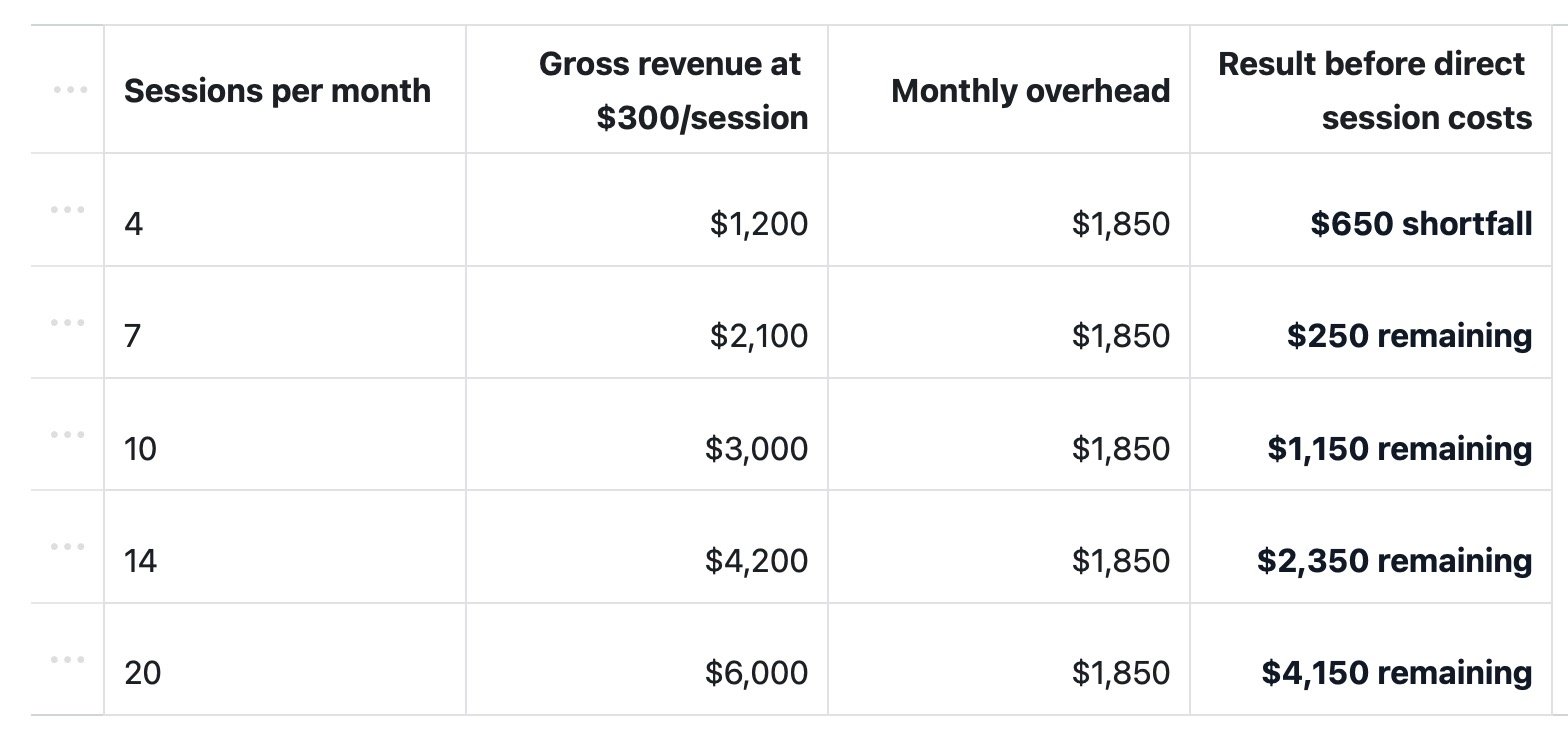
Monthly operating picture at a theoretical $300 session price
This first table shows gross session revenue against the $1,850 monthly overhead only. It is still before direct session costs.
Contribution-margin reality check
Now add an illustrative $100 in direct costs per session for editing or labor allocation, payment processing, consumables, and other booking-specific expenses. That $100 is a placeholder each photographer should replace with their own number, and it does not automatically represent fair owner pay.
$300 session - $100 direct costs = $200 contribution per session
$1,850 monthly overhead ÷ $200 contribution = 9.25, so approximately 10 sessions/month to reach operating break-even
What that looks like by session count:
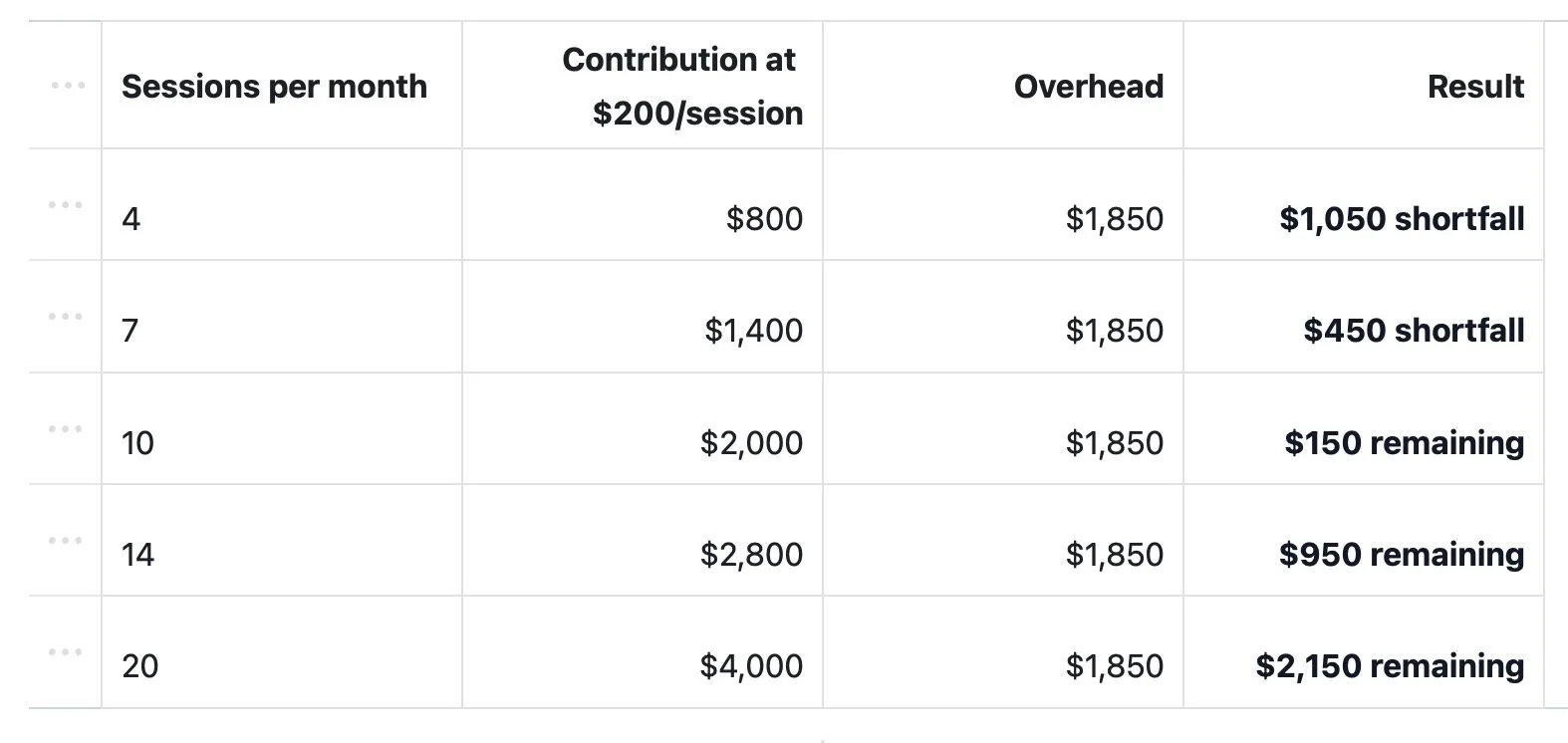
Even at 10 sessions/month, that $150 remainder is not “profit” in the everyday sense. It does not pay the owner fairly, cover taxes, repay startup costs, replace equipment, or build a reserve.
If the owner wants to pay themselves $3,000/month, the target becomes $4,850 of contribution before taxes and reserves. At $200 contribution per session, that requires approximately 25 sessions. This is illustrative math, but it shows how quickly “break-even” and “actually sustainable” become two very different conversations.
Preparing for building clientele
Slow to book? It doesn’t mean you’re failing!
Industry averages place new businesses at a 12 to 18 month run before the hit the breakeven point. Having an established photography company can help to shorten this window, but it takes time to get the word out an establish clientele when starting something new.
Cash-Runway
Hope for the best, but prepare for the worst. If you’re not busy in the first few months or even the first year, Runway are the funds set aside for maintaining operations while bookings are still catching up. For operating overhead only, having the following reserves or extra cash flow on an 800-square-foot model will theoretically place you in a zone of comfort where you don’t have to stress about closing your doors early.
Three months of $1,850 overhead = $5,550
Six months = $11,100
Twelve months = $22,200
Model three versions:
Conservative: slower bookings, lower pricing, higher repairs
Expected: realistic utilization and normal expenses
Optimistic: faster demand and stronger average booking value
Track cash-flow positive, operating break-even, owner pay, startup-cost recovery, and true profit as separate milestones.
Opening your own studio? What’s worth investing in?
Invest in what clients feel
People may arrive because they love your images, but they come back because the experience felt easy, calm, and worth repeating.
The studio experience clients actually come back for
Repeat clients usually are not thinking, Wow, what a nice square footage number.
They are responding to the things that reduce uncertainty, discomfort, and production friction while giving them a result they cannot easily recreate at home.
That often looks like:
Reliable, flattering, controllable light
Privacy and a place to change comfortably
Temperature control, especially in North Carolina heat, humidity, or unpredictable weather
Cleanliness and a professional environment
Easy parking, load-in, restroom access, and accessibility
Clear booking, pricing, arrival, and cancellation information
A calm, welcoming greeting and responsive support
Enough room to move, direct, pose, and create variety without cramped frames
Comfortable seating, mirror or beauty access, beverages, and practical hospitality where appropriate
Consistent sets, backgrounds, props, and the ability to create more than one look
For video: manageable HVAC or room noise, sound control, reliable power, and space for cameras and audio
These are not luxury extras in the emotional sense. They are client-experience standards and planning considerations. They help people feel taken care of, less awkward, less rushed, and more confident in the outcome.
Research from the Professional Photographers of America points toward clients valuing the overall experience, not just the final image. A clean studio with clear instructions and easy booking can feel more professional than a more expensive space with confusing policies and friction everywhere.
Prioritize first
Reliable, flattering, controllable light
Clean, flexible backgrounds
Enough room to move without distortion
Temperature control and privacy
Clean restrooms and changing space
Parking, load-in, seating, and accessibility
Clear pricing and simple booking
Responsive communication
Safe power, cable management, and fire protection
Basic sound control if you offer interviews or video
A small, curated prop or wardrobe selection
Mobile-friendly galleries and practical delivery systems
Let these wait
Huge prop collections before demand is proven
Furniture purchased because it looks good but serves no booking
Multiple specialty lights before mastering the core system
Elaborate lounges and decorative renovations
Full-time staff before utilization supports payroll
Large inventory bought on speculation
Gear that can be rented for a specific booking
A useful rule: buy what improves safety, reliability, comfort, image quality, or booking capacity first. Delay what is mostly decorative or hard to monetize.
A real look at rental vs. owning. What does break-even and profit really look like?
Break-even is not the same as profit
Operating break-even means the studio covers its monthly business expenses. True profitability also pays the owner fairly, replaces worn equipment, builds reserves, and eventually recovers startup costs.
For the examples below, use a clearly labeled theoretical example:
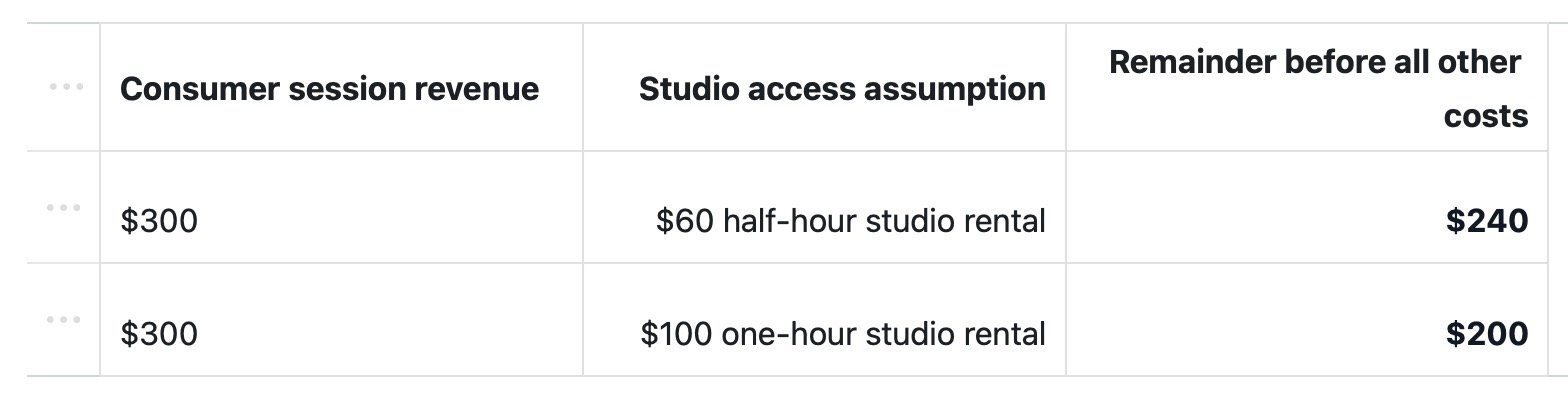
$300 consumer session revenue for cost modeling
$60 for a 30-minute studio rental
$100 for a one-hour studio rental
For the examples below, let’s assume you’re charging $300 per session and let’s base the rental fees on what we charge — $60 for a 30-minute rental and $100 for a one-hour rental.
In this scenario, we’re using the following formula: Monthly fixed costs ÷ contribution margin per booking = bookings needed for operating break-even
Contribution margin is booking revenue minus variable costs such as payment fees, assistants, consumables, editing labor, and booking-specific rentals.
Rent versus lease: the reality check
Renting keeps studio cost variable while you learn the market. A lease creates the bill whether the room is booked or empty.
If studio access is rented only when needed, the monthly access bill scales with demand.
At $100 per one-hour rental:
10 studio sessions/month = $1,000 in access cost
20 studio sessions/month = $2,000
30 studio sessions/month = $3,000
45 studio sessions/month = $4,500
At $60 per 30-minute rental:
10 studio sessions/month = $600
20 studio sessions/month = $1,200
30 studio sessions/month = $1,800
45 studio sessions/month = $2,700
A lease only begins to look cheaper on access cost once usage approaches the lease’s all-in monthly cost. And even then, “cheaper” gets slippery fast because ownership adds more than access cost alone:
Utilities
Insurance
Maintenance and repairs
Downtime between bookings
Cleaning
Build-out and furnishing
Security deposits
Administrative burden
A theoretical per-session example for renting a studio
If the consumer pays $300 for the session, and studio access costs are taken out first, the remaining amount is not profit. It is simply what is left before all other costs.
Monthly example: 20 total sessions using a rental studio
Let’s pretend for a second, that you can fill 20 studio sessions a month at $300 per session.
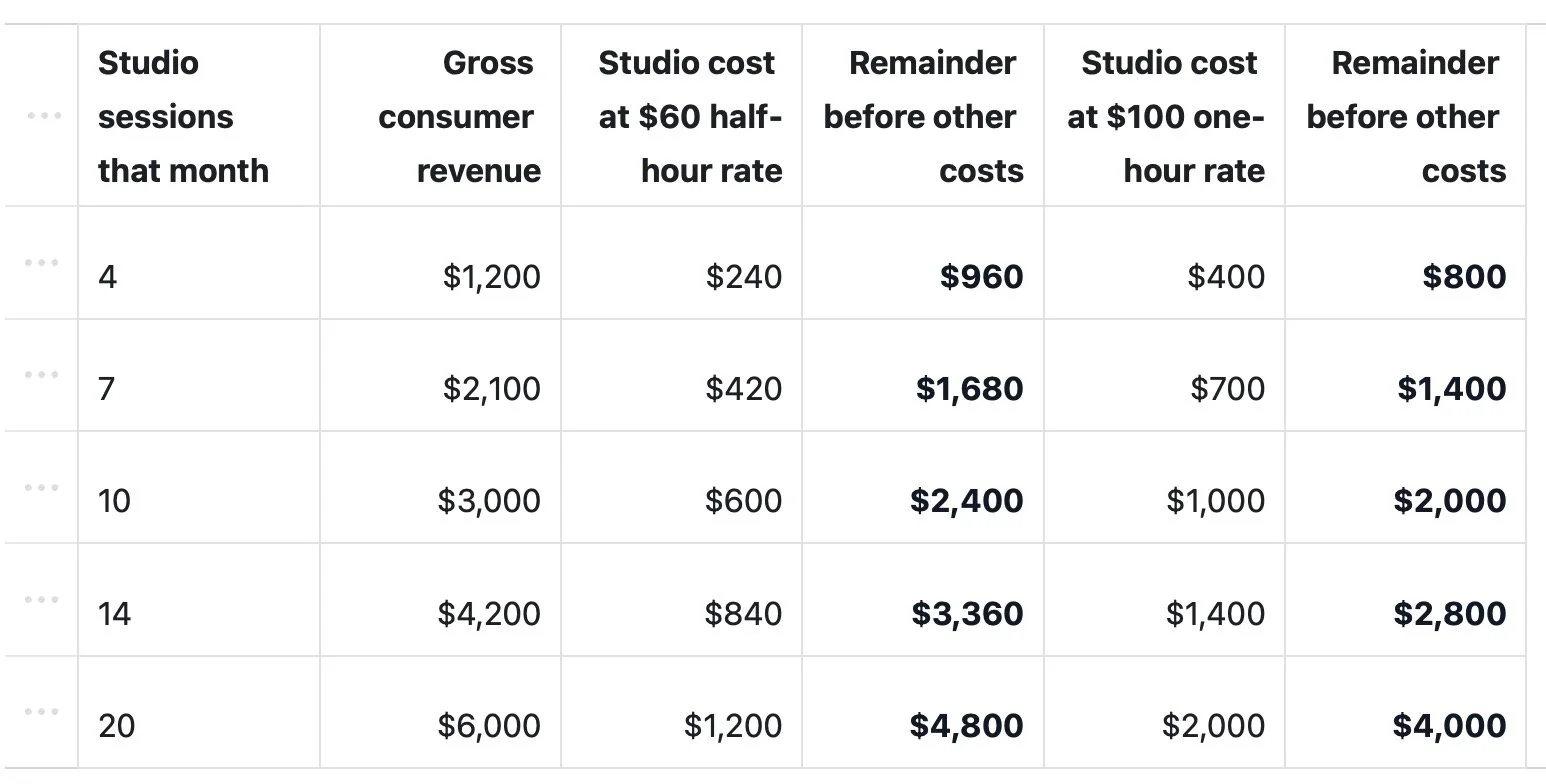
The key here with renting is that you begin taking home a profit beginning with the very first session. In practical terms, if you’re planning on opening your own space, the question really comes down to: Do you already have the number of sessions and clients needed to hit the breakeven point, and even then are you making enough to take home that you feel comfortable with?
The fixed-lease problem
The scale of the overhead matters.
In the favorable 800-square-foot example above, operating break-even lands at approximately 10 sessions per month if contribution is about $200 per session, and that is still before owner pay and taxes.
This is what makes having a dedicated commercial studio a little harder to swallow — at least at first. Without the runway to really gauge exactly how many sessions you might have, it’s impossible to know exactly how much runway is going to be needed and for how long before you can reach the barrier of breakeven.
Even then, a small bare-bones studio can be cheaper to open, but it can also be harder to sell if the experience, variety, comfort, and visual payoff are not substantial enough to excite consumers. Slow bookings are not personal failure. But they are expensive.
The Strategy for Rent vs. Open Your Own
Looking for a cost-effective path that lets you gain statistics and build clientele first? Rent first and open only when the math agrees.
Stage 1: Rent first
Use rentals to test real demand, actual studio usage, pricing tolerance, category performance, and repeat bookings before fixed overhead joins the group chat.
Stage 2: Open your own only when the math agrees
A dedicated studio starts to make sense when your data, not just your excitement, shows that demand and cash flow can carry the fixed cost month after month.
This guide is a planning tool for photographers considering a dedicated studio, particularly in North Carolina and the Jacksonville, Richlands, and Onslow County area. The numbers are estimates, not quotes. Lease terms, construction, equipment ownership, debt, taxes, and owner labor can change the result dramatically.
Most importantly: slow profitability is normal. When bookings are quiet, it can feel personal, like the studio is proof that you made the wrong decision. Often, it is simply a business still finding its rhythm.
How much are rental studios investing?
What large, full-service rental studios are really investing in
A professional rental studio is not simply buying a few lights and hanging paper. They are normally working to create the kind of destination-level experience that excites clients or attracts rental customers. This is a look at what a typical rental studio is investing in.
It is usually investing in:
Commercial lease deposits and rent
Build-out, electrical, HVAC, flooring, paint, walls, and repairs
Permanent shooting infrastructure such as a cyc wall
Multiple styled sets and flexible shooting zones
Professional lighting, modifiers, grip, and backup equipment
Backdrops, props, furniture, client closet, and storage
Privacy and changing areas
Restrooms and hospitality
Sound control and video capability
Booking and access systems
Cleaning, maintenance, insurance, security, internet, and staff time
Operating runway while the space builds awareness and utilization
How much investment goes into large scale rental studios?
As an anonymized real-world scale example, recreating a large, multi-set, client-comfort-focused studio with substantial inventory can require:
Lean but credible version: $175,000–$250,000
Realistic recreation: $275,000–$425,000
Fully polished, build-out-heavy version with healthy runway: $425,000–$600,000+
A large studio that is investing in the items above is easily in the $300,000–$400,000 for build-out/equipment/inventory and $50,000–$75,000 in operating runway, or about $350,000–$475,000 all-in.
This is where renting can give you your greatest power — the ability to have more space, resources, offerings and comfort for your clients, without the burden of the heavy startup costs.
Test before committing
Before you sign anything, it may be beneficial to rent first for a season and treat it like field research.
Try this checklist:
Rent for 3–6 months
Track how many total sessions are studio versus outdoor or on-location
Track revenue and contribution after rental costs
Record which categories convert best: branding, headshots, maternity, family, product, content, video, and similar offers
Ask clients what made them choose the studio and whether they would return
Test weekday, weekend, mini-session, content-day, and seasonal offers
Build an interest list or pre-sell before signing
Track repeat bookings and referrals
Model 6, 12, and 18 months of cash flow
Test whether the business needs rental, membership, workshop, or event revenue in addition to the photographer’s own sessions
You are not “wasting time” by renting first. You are buying information before you buy fixed overhead.
A practical decision framework
Want the safety net? Below is a strategy for reserving cash flow until you’re ready to take the leap.
Choose rent first when:
Studio sessions are a minority of your work
Consumer pricing is close to the theoretical $300 consumer-session example used in this article
Savings are limited
Demand is unproven
You want flexibility
Even a favorable small-studio model has not yet been validated by several months of real demand
Choose test and track when:
There is interest, but you have fewer than 10 consistent paid studio sessions per month
Repeat demand is still unclear
You need proof that the studio-centered offer works beyond early enthusiasm
Choose consider opening only when:
Several months of demand are proven
The offer is clear
Runway is sufficient
Conservative math works
You have tested whether the space creates enough client value and repeat demand to support the model
Recap
The real question is not just can you open a studio. It is when should you rent, and when should you own.
A lean studio may cost $5,000–$12,000 before reserves, but that is an open-the-doors scenario under favorable assumptions, not automatically a polished client experience.
A small dedicated studio is more realistically $15,000–$35,000 before operating reserves.
A polished build-out can reach $35,000–$80,000+, and a destination-level multi-set studio can require far more capital.
Lease deposits, build-out, and rent usually matter more than props.
Invest first in light, safety, comfort, reliability, flexibility, and booking capacity.
Operating break-even and true profitability are different milestones.
In this article’s theoretical $300 consumer-session example, studio access is illustrated at $60 for a 30-minute rental or $100 for a one-hour rental.
In that model, renting is not a lesser model. It is a strategic testing tool.
A lease usually becomes easier to justify only when demand is proven, contribution is healthy, and the studio can carry real fixed overhead under conservative math.
In this article’s two examples, a favorable 800-square-foot model may reach operating break-even at about 10 sessions/month at $200 contribution per session, before owner pay and taxes, while a larger $4,500-overhead model may require roughly 23–45 sessions/month depending on contribution.
Third-party planning estimates commonly place break-even around 6–18 months, but that is an informal planning range, not a schedule the universe is obligated to keep.
Keep three to six months of fixed expenses in reserve whenever possible.
Keep sourced statistics separate from local planning assumptions.
If bookings are slow, treat the pattern as information. A business model can need adjustment without the person behind it being a failure.
Renting first is not thinking small. It is buying information before taking on fixed overhead.
Planning note: This article is educational and is not financial, legal, insurance, construction, or tax advice. Public-market context and sourced statistics are cited below. Session-pricing and rental examples in the theoretical $300 consumer-session model are illustrative only and are not universal market averages or recommended rates. Verify current fees, permits, zoning, lease terms, insurance requirements, and contractor pricing with qualified local professionals.
Sources and further reading
Jacksonville/Onslow commercial listings and Crexi listings: current asking-rate examples, not official market averages
Third-party break-even estimates from Circular Studios, Startup Costs, and IdeaFloat: informal business-guide estimates, not audited industry statistics